Archive for September, 2009
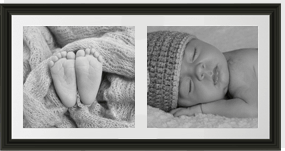
If you are serious about baby photography and you tend to shoot from your own studio make sure you have a lot of toys to amuse the infants. A light colour background will work best and shoot the portraits in colour and black and white.

Parents may be worried about the affect of studio lights on their baby. Point out that strobe lights have no effect on kids. Try to point this out before the parent asks.
Don’t ever handle a baby without the parents consent. Most parents will be very protective and won’t react well to a stranger lifting the infant.
Watch out for the fingers – fingers in the mouth can be attractive but on most occasions they will obscure the face.
Once you have that sorted and have some great shots all this is left is to select your picture frames and work out where you’re going to hang your masterpiece.
The PFE Team
Babies can be the most challenging and rewarding portraits to take, but can also be the most frustrating… for both of you!

Babies tend to sleep, eat and cry a lot and won’t pose in front of the camera but don’t let that put you off photographing them. Creating the perfect baby portrait, when done right, will certainly be rewarding.
One of the most important factors in photographing babies is patience and the way you apply child psychology when relating to the baby. Babies over six months may be shy and won’t react well to a complete stranger. This is where child psychology comes in – you must try to play with the baby, or even become a child yourself while taking the photograph. The keys of your car can be very effective. But remember, your job is to take a baby portrait; you must be able to react quickly when the infant responds to your entertainment.
Shooting a portrait of a newborn baby can be difficult. At this age the baby will not be active, so it’s better to focus on close-up headshots. Try using natural light from a bedroom window to add mood to the portrait.
Babies over a few months of age will be more alert and will have a lot more movement in them. Shooting fast is a necessity, the infant will tire quickly.
Babies seven months or older can be very tricky to shoot. The baby will bore quickly and will not want to stay in the same position.
Part #2 in a day or so
The PFE Team
“Never have I found the limits of the photographic potential. Every horizon, upon being reached, reveals another beckoning in the distance. Always, I am on the threshold.” -W. Eugene Smith
photo: © W. Eugene Smith / Magnum Photos
The invention of the camera liberated painting from its reportage role. Gone was the need to produce a likeness, detail the events of the story, painting was free to express emotions. True what had gone before contained an emotional content but now painting could experiment and through imaginative interpretation allow the emotional content to predominate. Freed from this constraint the painter was able to create a new language and explore the motivations of their art. Read the rest of this entry »
Picture frames come in hundreds of colours, different shapes and a wide variety of materials which will complement the interior decoration.
The photo frames are made of pewter, stainless, ceramics, composites and crystal. Your budget is the only criteria to select the best available design and material.
Picture frames can be artful in their own right with wide borders, bright and bold colour. Try to avoid a picture frame which overwhelms the image it carries.
One ancient proverb says a picture is equal to thousand words. What about picture frames. The main function of a picture or photo frame is to protect and highlight the content it holds. A beautiful work of art can be made to look drab by framing it improperly, using wrong materials. Similarly an excellent frame can definitely enhance the beauty of the picture it holds.
There are frames and there are frames but to select which is most suitable for the picture or photograph it is going to be a very difficult job. A wrong choice and you lose the contented feeling you get when you look at a work of art.
Have you already mastered the art of taking photos without ‘red-eye’ syndrome?
Are there some pictures that you know you should have turned out a lot better than they did?
It happens to all of us – even the Jedi masters expert photographers.
Here are five tips to help you move from beginner to Jedi master of digital photography, whether you’re using your mobile phone or a point-and-shoot camera to snap shots. Read the rest of this entry »
Here is our follow up from yesterday; another three great photography tips:
3. Carry only what you need: Carry only the essentials. You don’t need to upload your camera bag with every piece of equipment you own. If you are going to be out taking pictures all day you are much better off going as light as possible. Carrying a light load will also help preserve energy. You could be climbing icy rocks or crossing snow filled hills; a warm flask would serve you a lot better than a third camera.
4. Look for detail: Snow, ice and frost bring out texture and atmosphere in most subjects. The early frosty morning is an ideal time for close-up photography. The frosty morning also brings out patterns in our landscapes.
Take care where you place your camera: if you are taking pictures early in the morning try placing it at oblique angles to the sun – this will give your images strong shadows. This will also add mood to your landscape images. Once you have found the perfect spot pay extra attention to foreground interest as this will add depth to your image.
5. Expose carefully: Snow and ice are extremely difficult to expose properly. Snow usually confuses your cameras metering system or your hand held light meter. When you take a light reading from snow you will automatically get an underexposed image. The meter will record the snow as grey.
That’s it for our winter photography tips have a look around the blog and the site and we’ll have more photography and picture framing tips for you soon.
The PFE Team
Winter brings out the toughest elements in our climate, with many people putting away their camera bags ‘till early spring. But, if you do put away your camera you are missing out on the raw beauty that this magical season brings.
Here are a few tips to make the trip more enjoyable.
1. Wear the right clothes: It’s very important to wrap up warm when out shooting winter images. The winter season brings the toughest elements, so if you are planning to spend a few days out and about always be well prepared.
2. Watch the weather: It’s very important to know what the weather is going to be like. You don’t want to travel for a couple of hours and then hear a weather report that tells you that: the weather is wet for the next few days. During the winter months the weather can dramatically change in a matter of hours.
It’s always advisable to let someone know where you are going and which route you’re planning to take. If you do get injured or ever caught in a storm someone may be able to help.
Come back tomorrow for another two tips on Shooting Winter Landscapes. In the mean time why not have a look at our seletcion of frinton pine picture frames? Ideal for winter landscapes.
Just bought a new camera? And very excited to start taking photos with your new gadget?
But Alas, why does the picture not look as good as you wanted to !! Fret no more, stay tuned below for 4 new tricks to taking more interesting and memorable photos.