






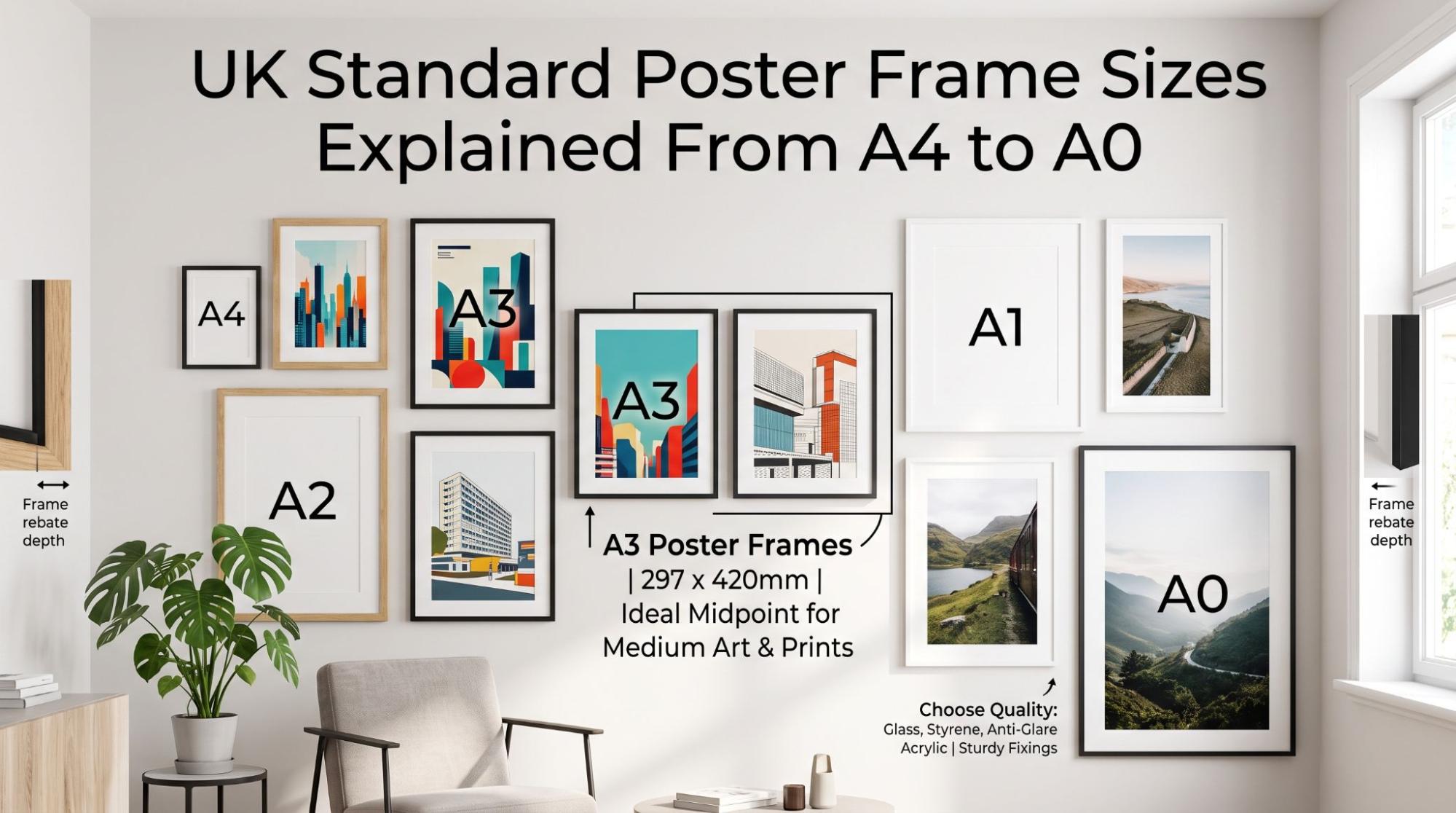
UK Standard Poster Frame Sizes Explained From A4 to A0
Navigating the landscape of UK framing dimensions often presents unexpected challenges for graphic designers, commercial print buyers, and interior-conscious homeowners alike. This comprehensive guide clarifies how international paper standards directly dictate picture frame selection across both commercial and domestic settings. By thoroughly examining the standard ISO 216 framework, we break down the clear geometric logic that governs A Series Sizes from compact A4 prints up to expansive A0 promotional displays. You will discover exact sheet measurements in both millimetres and centimetres to ensure your chosen artwork sits perfectly within its mount without unsightly gaps, creasing, or clipped edges. We also explore practical trade-offs between traditional glass and lightweight acrylic glazing alongside rebate depth calculations and mounting board considerations. Whether you are prepping a stylish gallery wall at home or hanging retail point-of-sale graphics in a shop fitting project, this technical reference delivers straightforward guidance to help you select precisely matched poster frames every single time.
Selecting the correct display enclosure for your home or commercial property ought to be a quick and thoroughly satisfying task. Recent ONS home improvement data indicates that 34% of UK property owners renovated their main living spaces during the past year, proving that stylish interior presentation remains a major priority nationwide. However, ordering an incorrectly proportioned casing often leads to crumpled paper trim, distorted graphics, or expensive return shipping costs.
Understanding how standard paper dimensions correspond directly to off-the-shelf frame apertures will save you considerable time, money, and unnecessary hassle on every single project.
Let us break down the foundational maths of British poster dimensions so you can specify your display hardware with total confidence.
KEY TAKEAWAYS
- –UK poster sizing follows the standardised ISO 216 scale where each larger size exactly doubles the total surface area of the preceding paper dimension.
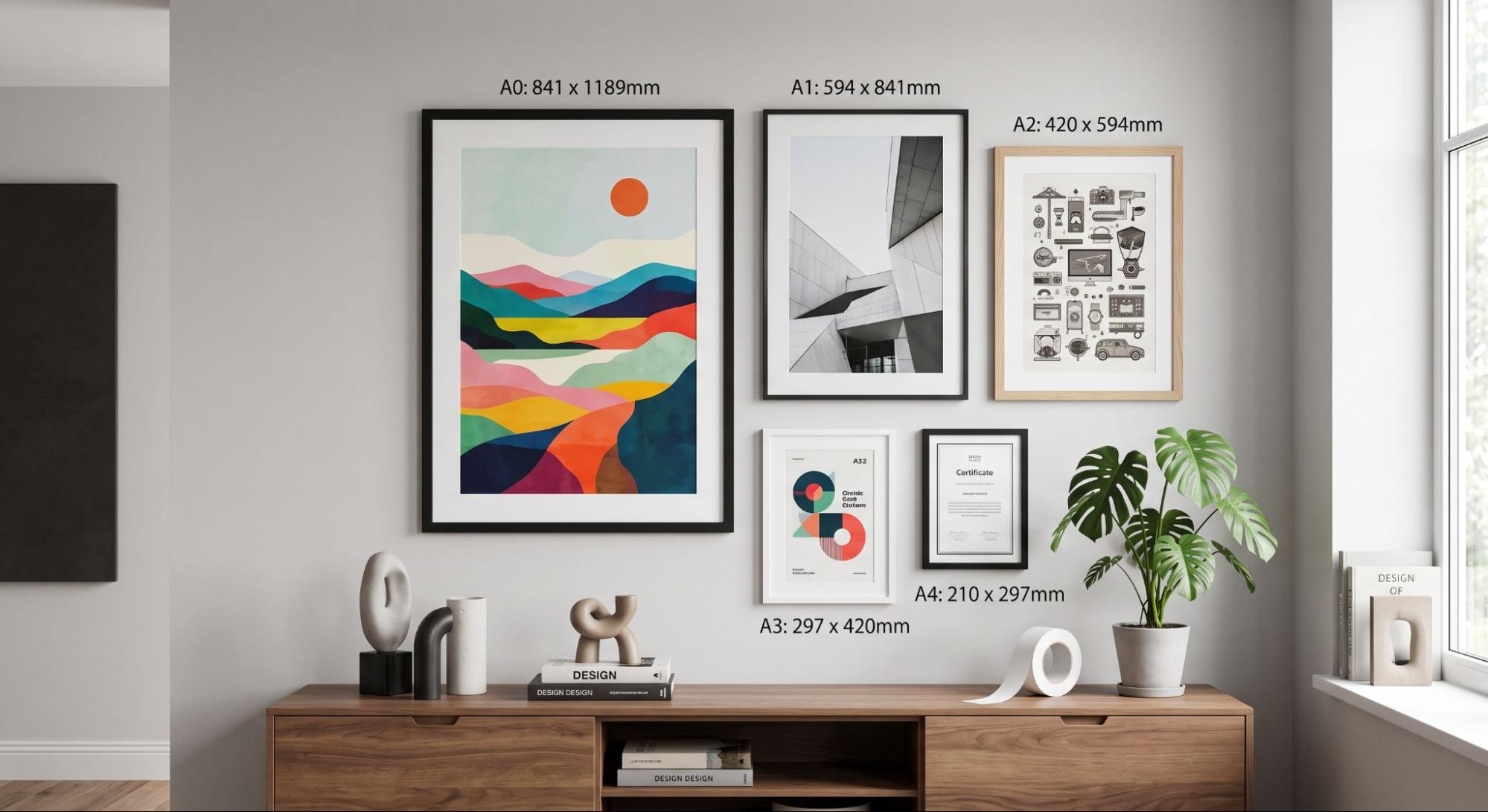
- –Standard A Series Sizes range from compact A4 measuring 210 by 297 millimetres up to full scale A0 poster formats measuring 841 by 1189 millimetres.
- –Confirming precise dimensions in both millimetres and centimetres ensures seamless compatibility with off-the-shelf frame mouldings, mount boards, and commercial clip displays.
Need Expert Advice on Your Project?
Speak to our technical team today for tailored specifications and compliance guidance.
A4 Poster Frames for Small Displays and Certificates
Precision Dimensions and Paper Specifications
The A4 Size remains the most ubiquitous print standard across the United Kingdom, measuring precisely 210 x 297 mm. When selecting an enclosure for this format, the internal rebate is engineered to match these exact paper dimensions, ensuring a flush fit for standard office paper, card stock, and official certificates. Precision manufacturing ensures that edge bleed, serial numbers, and text margins remain completely visible through the display aperture.
Commercial venues, healthcare settings, and educational institutions rely on these compact enclosures because they accommodate standard printouts without requiring bespoke trimming or mounting mats. The clear glass or shatterproof styrene glazing protects delicate paper inks from grease, dust, and environmental wear, making it a dependable choice for displays that require routine updating.
Versatile Functionality with Desk Frames and Small Wall Frames
Dual-purpose engineering makes this format exceptionally versatile across modern business environments. Many manufactured options in this size class feature integrated rear strut backs that transform them into sturdy Desk Frames for reception counters, office desks, and retail till points. These rear kickstands allow seamless switching between portrait and landscape orientations depending on the orientation of your document.
For wall-mounted eye-level placement, integrated rear fixings transform these units into small wall frames suitable for narrow corridors, doorways, or staff notice boards. Purchasing bulk commercial packs can reduce unit procurement costs by up to 25%, bringing individual unit prices down to around £3 for basic extruded plastic or aluminium profiles. Premium solid wood or brushed metal options typically cost between £8 and £18 per unit, offering an authoritative finish for high-profile accreditations.
Typical Applications and Certificate Framing Solutions
Official documentation requires robust protection to maintain a crisp aesthetic over extended periods. Industry awards, vocational diplomas, and regulatory notices are predominantly printed on standard 210 x 297 mm sheets, making this size the standard container for corporate compliance assets. A slim 15 mm frame border provides a subtle accent around the document without visually overcrowding smaller rooms or office cubicles.
For fast-paced commercial spaces, front-loading snap frames offer a highly functional solution. These mechanisms allow staff to swap safety policies and promotional flyers in seconds without removing the backing structure from the wall. The spring-loaded aluminium profiles hold the media perfectly taut, reducing the risk of paper slumping or creasing by over 90% compared to unframed posters fixed with basic adhesives.
A3 Poster Frames for Medium Wall Art and Art Prints
Understanding A3 Dimensions and Framing Essentials
An A3 Size print measures precisely 297 x 420 mm, offering double the total surface area of standard A4 paper. This specific geometric format hits the ideal midpoint between modest desktop document framing and large-scale advertising displays, making it a cornerstone size in British print framing. When selecting medium poster frames for prints of these dimensions, paying strict attention to internal edge tolerances and rebate depths ensures the graphic sits perfectly flat against the backing board without buckling.
Framing artwork with these exact proportions requires a clear practical understanding of sightlines and borders. Standard frame profiles usually overlap the paper edge by roughly 5 mm on all sides to hold the media securely inside the enclosure. If you choose to add an acid-free mount board, the overall frame size will expand, requiring a larger external moulding to maintain correct visual proportions across the display surface.
Versatile Applications for Medium Poster Frames
This popular scale works exceptionally well for architectural illustrations, high-resolution photography, art prints, and promotional event posters. Because the dimensions hit an optimal sweet spot for short to medium indoor viewing distances, commercial graphic designers frequently select this scale for interior venue signage, corporate notices, and retail window displays where space is limited.
Purchasing ready-made display solutions typically costs between £15 and £45 per unit, depending on whether you choose lightweight extruded aluminium, durable plastic, or natural solid oak mouldings with stained finishes. Commercial clients and gallery owners frequently purchase these units in bulk to achieve clean visual consistency across an entire building, often securing up to a 20% discount on large trade orders.
Selecting Quality Options with Frames Express
When sourcing framing hardware from industry specialists such as Frames Express, buyers can choose from a range of protective glazing materials to preserve their artwork. Standard float glass offers excellent optical clarity for home residential interiors, whereas shatterproof styrene or clear acrylic glazing provides a far safer alternative for high-traffic public areas, schools, and commercial corridors.
Upgrading to specialized anti-glare acrylic removes up to 90% of harsh reflections caused by bright sunlight or direct overhead light fixtures. Combined with sturdy rear fixings that allow for immediate portrait or landscape wall mounting, professional grade enclosures protect delicate paper stocks from environmental dust and humidity while maintaining crisp, professional presentation over many years of continuous use.
A2 Poster Frames for Feature Prints and Gallery Walls
Technical Dimensions and Visual Impact
The standard A2 Size measures exactly 420 x 594 mm, which represents half the surface area of an A1 sheet and double that of an A3 print. This specific format strikes a precise balance between compact readability and grand visual presence. In graphic design and retail display, an A2 enclosure offers enough surface area to showcase intricate typography and fine photographic detail without overwhelming modest British room proportions.
When selecting frames for prints of this dimension, technical precision is paramount. The internal rebate of an A2 frame must accommodate the standard 420 x 594 mm sheet with an engineered tolerance of 1 to 2 mm to prevent paper buckling caused by seasonal humidity changes. Standard moulding widths for this size typically range from 20 mm for modern aluminium profiles to 35 mm for traditional wooden designs, giving structural integrity while maintaining focus on the artwork itself.
Mount Board Options for Feature Wall Art
Using custom mount board options transforms an ordinary print into refined feature wall art. A classic setup involves placing an A3 print inside an A2 frame, secured by a conservation-grade mount board with a 45-degree bevelled aperture. This creates a generous border of roughly 60 mm on all sides, drawing the eye directly toward the central image while protecting the paper surface from direct contact with the glazing material.
For full-bleed A2 prints, mounting directly against acrylic or glass requires high-grade fixings to prevent slipping. High-street picture framing options in this category generally start around £25 for basic extruded plastic units, whereas professional solid oak or powder-coated aluminium frames often sit between £40 and £85. Selecting acid-free backing boards is essential to prevent yellowing over time, ensuring your display retains its original colour accuracy.
Gallery Wall Layouts and Spatial Metrics
In multi-frame arrangements, the A2 format acts as an anchor element around which smaller A3 and A4 pieces rotate. Interior designers frequently recommend maintaining a minimum gap of 75 mm around an A2 centrepiece to prevent visual clutter. When positioned as a central graphic element, an A2 frame commands roughly 30% of the visual weight on an average domestic chimney breast, making it an effective focal point.
Achieving a professional finish across a gallery wall relies on consistent frame depth across all units. Combining A2 frames with smaller formats requires careful alignment along either the top edge or the central horizontal axis. Using lightweight acrylic safety glazing rather than standard glass reduces total weight by over 40%, which simplifies hanging requirements on standard British plasterboard walls.
A1 Poster Frames for Large Art and Commercial Displays
Exact Dimensions and Spatial Impact
The standard A1 Size measures precisely 594 x 841 mm. It offers a total surface area of approximately half a square metre, making it one of the most versatile formats in modern commercial framing. This specific format provides a substantial canvas for high-resolution photography, promotional graphics and architectural prints without overwhelming smaller retail premises or domestic wall spaces.
When selecting a frame for prints measuring 594 x 841 mm, professional installers must account for both the visible graphic area and the external moulding dimensions. Profile widths typically range from 25 mm to 45 mm depending on structural requirements and visual style. A standard front-loading snap frame using a 32 mm profile will add roughly 64 mm to both total width and height, which is an essential calculation when planning multi-frame display arrays in tight spaces.
Glazing Specifications and Safety Standards
Large format displays require careful consideration of front panel materials. Traditional float glass becomes prohibitively heavy and hazardous at this scale, which makes high-grade Acrylic Glazing the preferred choice for professional installations. Lightweight sheet acrylic panels reduce the overall structural load on wall fixings by up to 50% compared to standard float glass alternatives.
Commercial environments with high footfall usually specify shatterproof Safety Acrylic to ensure compliance with health and safety regulations. This material resists high impact, prevents injury in public spaces and drastically reduces maintenance replacement costs over time. Furthermore, premium acrylic options incorporate ultraviolet filters that block around 99% of damaging light rays, effectively preserving print pigments for years. Basic aluminium frame units start around £20 each, whereas specialised fire-retardant commercial enclosures cost significantly more.
Mounting Systems and Structural Integrity
Securing an A1 frame requires robust fixing hardware due to the structural leverage created by the larger profile dimensions. Wall-mounted commercial units generally rely on four corner fixings concealed behind spring-loaded clip profiles. Hanging kits using twin steel cable arrays are also popular for floating window displays in estate agencies, banks and retail stores.
To ensure the paper graphic remains perfectly flat across its entire surface, rear backing boards are manufactured from high-density MDF or rigid corrugated plastic. This structural backing prevents paper from sagging, rippling or warping inside the frame rebate over extended display periods. Proper backing choices extend print lifespan and maintain high professional visual standards across changing ambient humidity levels.
A0 Poster Frames for Maximum Impact Wall Displays
When specifying displays for grand architectural spaces, understanding the precise dimensions of the largest standard ISO 216 paper format is essential. An A0 Size print measures precisely 841 x 1189 mm, covering a total surface area of exactly one square metre. Displays of this scale command immediate attention across expansive interiors, making them the primary choice for retail flagship stores, transit hubs, cinema foyers, and exhibition halls.
Dimensions and Engineering Principles
Successfully housing an 841 x 1189 mm print requires specialised Large Format Framing techniques to prevent paper sagging, surface rippling, and structural distortion over time. Standard float glass glazing is rarely suitable for frames of this magnitude due to safety hazards and excessive physical weight. Instead, commercial specifiers opt for 2 mm or 3 mm UV-stabilised clear acrylic glazing, which reduces total unit weight by up to 50% while providing superior shatter resistance.
Backing materials must also be selected with structural stiffness in mind. High-density MDF backing boards or rigid twin-wall polypropylene panels ensure the poster sheet remains flat against the front glazing. This internal support prevents visible bowing caused by fluctuating ambient humidity levels within commercial buildings. Heavy-duty spring clips or mechanical turn-buttons distribute rear pressure evenly across the perimeter.
Moulding Profile Depth and Mechanical Support
The selection of Moulding Profile Depth directly dictates the structural integrity and aesthetic presence of the finished display. For an A0 frame, a moulding depth of at least 25 mm to 35 mm is recommended, paired with a front profile width of 32 mm or greater. Anodised aluminium snap frames featuring internal steel springs are the industry standard for rapid promotional changes, whereas solid hardwood mouldings require glued and pin-reinforced corner joints to withstand the leverage forces exerted across the long span.
Wall fixings must be engineered to handle both static weight and accidental impacts in busy public zones. Professional installers fit heavy-duty keyhole zinc brackets or direct wall-anchor fixings through the internal frame channel, avoiding hanging wires that can stretch or cause the frame to tilt over time.
Commercial Return and Procurement Considerations
Allocating budget to maximum-impact framing solutions offers strong returns for high-footfall commercial environments. Retail studies demonstrate that switching key promotional graphics from A2 to A0 size increases customer visual engagement by up to 40%. Premium aluminium A0 units typically cost between £45 and £110 per frame depending on weatherproofing specs and lockable security features, representing a cost-effective infrastructure investment for long-term marketing campaigns.
Standard Imperial Poster Frame Sizes in the UK Market
Legacy Dimensions in British Retail and Display
While metric ISO standards dominate the modern print industry across the United Kingdom, traditional imperial measurements retain a major presence. High street retailers, framing studios, and commercial print houses frequently work with imperial dimensions alongside standard A-series options. Understanding these traditional measurements is practical when specifying frames for legacy print runs, photographic mounts, or imported artwork.
Imperial dimensions offer distinct proportions that differ from the tighter aspect ratios found in metric formats. Many established Commercial Poster Sizes rely on these traditional measurements to deliver maximum visual impact in store windows and outdoor display cases. Print buyers often choose imperial frames when framing historic advertising reprints, vintage travel lithographs, or promotional collateral produced outside continental Europe.
The Popular 20×30 Inches Medium Format
Among standard imperial options, the 20×30 Inches frame remains a steadfast choice across British commercial framing. Measuring approximately 508 by 762 millimetres, this format offers a generous display area without overwhelming smaller retail interiors. It serves as a direct descendant of the traditional Double Crown print size, making it a familiar sight in transportation hubs and retail venues across the country.
Off-the-shelf frames for this dimension are widely available in various profile materials, including extruded aluminium, painted MDF, and natural solid oak. Framing technicians often recommend a 20×30 Inches profile for promotional graphics, point-of-sale graphics, and classic railway art prints. Standard glass or lightweight clear acrylic glazing keeps overall unit weight low while protecting paper stock from ambient dust and environmental wear.
Cinema Standards and 24×36 Inches Specifications
For large format display, 24×36 Inches stands as the dominant imperial option in the UK market. Measuring roughly 610 by 915 millimetres, this size is deeply intertwined with Movie Poster Framing across domestic and commercial settings. Standard international one-sheet film prints fit neatly into these factory enclosures, rendering custom timber fabrication unnecessary for most collectors and cinema enthusiasts.
Choosing a mass-produced frame in this scale can reduce overall display expenses by over 40% compared to bespoke joinery options priced at £100 or more. For high-value film sheets, framers should select acid-free backing boards and conservation-grade UV protective acrylic. This setup preserves original print pigments while maintaining a sleek profile across residential, media room, or commercial interiors.
Smaller Imperial Options for Domestic Framing
Beyond large commercial media, smaller imperial sizes such as 12×16 inches and 16×20 inches fill an important niche in domestic picture framing. These mid-range options bridge the gap between small desktop photo frames and expansive wall-mounted displays. They allow homeowners to present art prints cleanly without requiring extensive wall space in narrower hallways or compact rooms.
Retailers supply these smaller imperial structures in various finishes, with black wood and brushed silver being especially popular. Choosing prefabricated imperial sizes rather than bespoke mounts allows consumers to save roughly 35% on standard home decor projects. These frames remain a practical choice for gallery walls that incorporate varied print origins.

Measuring Non Standard Prints for Made to Measure Framing
Accurate Measurement Techniques
Standard paper dimensions cover roughly 80% of off-the-shelf display needs across the UK, but vintage posters, imported prints, and original artwork frequently deviate from standard A-series dimensions. Measuring these unique pieces requires a firm steel tape measure or a rigid metal ruler rather than a flexible fabric measure, which can stretch over time. Always record measurements in millimetres to eliminate conversion errors and ensure absolute precision.
Lay your artwork completely flat on a clean, dry surface. Measure the total width and height at two separate points along each axis, taking note of both top, bottom, left, and right dimensions. Paper stocks can shift or expand over time due to atmospheric humidity, so taking multiple readings ensures you capture any slight bowing or irregular trimming before placing an order.
Accounting for Rebate Depth and Overlap
When opting for made to measure frames, you must account for the internal structural dimensions of the wooden or aluminium moulding. The lip inside the frame profile holds the glass, picture mount, and backing board securely in place. This internal channel relies on precise measurements, and understanding the Rebate Depth is necessary to ensure thicker artwork or mounted displays sit entirely flush against the rear board.
The inner lip usually covers between 5mm and 7mm of the outer edge of your print. If your print features important details, text, or artist signatures close to the perimeter, factor this overlap into your final calculations. If you plan to incorporate a decorative mount board, measure the exact sight area you wish to display, then let the framers calculate the final glazing dimensions accordingly.
Ordering Custom Frame Sizes Online
Specifying custom frame sizes online is straightforward when following a structured methodology. Enter the exact physical dimensions of your print into the sizing tool without adding extra tolerances yourself. The skilled technicians in the Frames Express Workshop automatically build a standard working tolerance of 2mm into the finished frame. This extra clearance allows the glass, mount, and backing to expand or contract with ambient room temperature changes without buckling.
Selecting the correct profile depth prevents long-term damage to delicate paper stocks and original prints. Heavyweight prints, textured canvases, or layered collages require deeper channels to avoid pressing directly against the protective acrylic pane. Spending a few extra minutes taking accurate physical measurements guarantees a tailored finish that complements your interior space while protecting your artwork for decades, saving potentially £50 or more in professional restoration fees.
Frequently Asked Questions around poster frame sizes uk
Our team often get asked lots of questions around poster frame sizes uk, here are some of the most common.
What are the standard ISO poster frame sizes used in the UK
In the United Kingdom, standard poster frames follow the international ISO paper sizing system. This system includes sizes ranging from A4 up to A0. An A4 frame measures 210 x 297 mm, while an A3 frame measures 297 x 420 mm. Moving up the scale, A2 frames measure 420 x 594 mm, A1 frames measure 594 x 841 mm, and the largest standard size, A0, measures 841 x 1189 mm.
Knowing these measurements makes selecting the right frame straightforward. Every size in the ISO range doubles in area as you move up from one step to the next, which keeps proportions consistent across all artwork.
How do I accurately measure a poster to choose the right frame
To find the perfect fit, always measure the outer edges of your paper print using a ruler or tape measure in millimetres. Frame dimensions listed by UK retailers always refer to the internal size of the frame where the image sits, not the total width of the outer plastic or wooden border.
If your poster measures exactly 420 x 594 mm, you need an A2 frame for a flush fit. Never assume a poster is a standard size without checking it first, especially if it was printed outside the UK or bought online from an independent artist.
What is the difference between framed with a mount and framed without a mount
Framing without a mount means your poster fits right to the edges of the frame glass. This is often called a flush fit, and it is ideal for modern graphic prints or full-bleed posters where artwork covers the entire page.
Using a picture mount adds a decorative card border around your poster. If you choose to use a mount, you must buy a frame that matches the outer size of the mount card rather than the poster itself. For example, an A4 poster with a standard mount border usually requires an A3 poster frame.
Are imperial poster frame sizes still common in the UK
While metric ISO sizes dominate the UK market, imperial frame sizes remain very popular for specific types of artwork. Classic movie posters, promotional displays, and imported prints from North America often use inches rather than millimetres.
The most common imperial sizes in the UK are 20 x 30 inches, 24 x 36 inches, and 27 x 40 inches. If you buy film memorabilia, you will likely need an imperial frame size to avoid trimming your poster or customising a metric frame.
What frame size is required for a standard UK cinema poster
Standard British cinema posters are traditionally known as Quad posters. These feature a landscape orientation and measure 30 x 40 inches, which equals roughly 762 x 1016 mm. They require specialist imperial frames because they do not match standard A-series dimensions.
If you have a modern foreign film poster, it might be a standard American one-sheet measuring 27 x 40 inches. Always check the exact orientation and dimensions before purchasing, as cinema prints rarely fit into standard A1 or A0 frames.
Why is acrylic glazing recommended for large poster frame sizes like A1 and A0
Large poster frames require lightweight materials to stay safe on your wall. Traditional glass becomes very heavy and fragile at sizes like A1 and A0, making it difficult to hang and prone to breaking during transit or installation.
Shatterproof acrylic, often called Perspex, offers clear viewing while reducing the overall weight of the frame. It is much safer for busy public spaces, homes with children, and large commercial wall displays.
What are snap frames and which sizes are available in the UK
Snap frames are front-loading aluminium frames designed for quick display changes. They feature clip-open sides that allow you to change posters without removing the frame from the wall. They are widely used in UK offices, schools, retail shops, and venues.
These commercial display frames are sold in all standard UK poster sizes from A4 up to A0. They are also available in weather-resistant outdoor versions to protect your posters from damp British weather.
Can I put a non standard poster into a standard UK frame
Yes, you can easily place a custom or non-standard poster into a standard frame size. The best way to do this is by ordering a bespoke picture mount cut to fit your specific poster size on the inside and the standard frame size on the outside.
Alternatively, you can create a floating effect by mounting your poster onto a piece of plain backing paper inside a larger frame. This saves you the expense of buying a custom-made frame while keeping your artwork neatly centred.
How wide should the frame border profile be for poster prints
The border width, or profile thickness, depends on both the size of your poster and your personal taste. Smaller frames like A4 and A3 look great with thin profiles around 15 mm to 20 mm wide, as this keeps the focus on the artwork.
For larger prints like A1 or A0, a wider frame profile of 30 mm or more provides necessary structural support. Thinner frames on very large posters can bow or flex under the weight of the backing board and glazing over time.
What is the best frame size for creating a gallery wall with posters
Creating an eye-catching gallery wall works best when mixing two or three complementary frame sizes. A popular UK combination uses a central A2 frame surrounded by a balanced mix of A3 and A4 frames.
Using standard ISO sizes makes planning your layout far easier because the proportional relationship between the frames looks naturally balanced. Measure your overall wall space first and leave a consistent gap of roughly 30 mm to 50 mm between each frame.
Need Expert Advice on Your Project?
Speak to our technical team today for tailored specifications and compliance guidance.

